
Article: The Digital Age is Rewiring Our Eyes And Not for the Better
The Digital Age is Rewiring Our Eyes And Not for the Better
The way we use our eyes today is fundamentally different from how humans have used them for centuries.
We were built to look far at landscapes, horizons, movement.
Today, we look near.
Constantly.
Phones.
Laptops.
Tablets.
LED screens.
This shift has quietly changed how our visual system functions.
The Rise of Continuous Near Vision
Historically, the human eye alternated between:
• Near focus
• Mid-range interaction
• Long-distance viewing
This constant variation kept eye muscles balanced.
Digital lifestyles eliminate that variation.
Now, the majority of our day is spent:
• Reading text at 30–40 cm
• Viewing screens at fixed distances
• Rarely engaging in distance focus
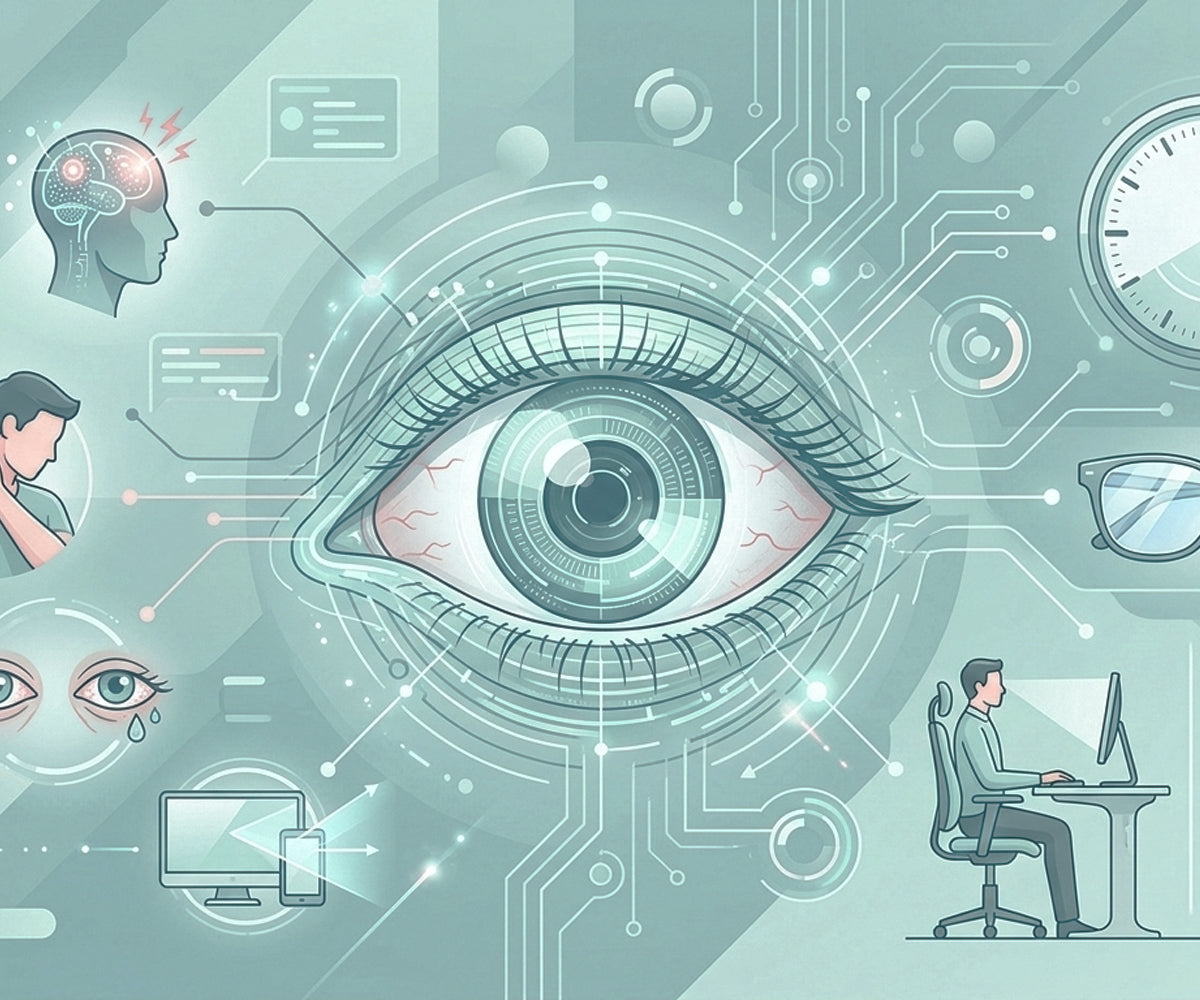
This leads to a condition known as visual system fatigue.

What Happens Inside the Eye?
When focusing on near objects for long durations:
• The ciliary muscles remain contracted
• Blink rate reduces significantly
• Tear film evaporates faster
Step-by-step impact:
-
Eye muscles remain in a locked state
-
Reduced blinking leads to dryness
-
Dryness causes irritation
-
Irritation leads to visual instability
Over time, this results in:
• Headaches
• Burning sensation
• Temporary blurred vision
• Difficulty shifting focus

The Hidden Brain Connection
Vision is not just an eye function it is a brain function.
Nearly 50% of the brain is involved in visual processing.
When visual input becomes strained:
• Neural processing load increases
• Mental fatigue rises
• Concentration drops
This is why digital fatigue often feels like:
• Exhaustion
• Lack of clarity
• Reduced productivity
The problem is not just tired eyes.
It is an overloaded visual-brain system.
Why This Matters Now
Screen time is not temporary it is permanent.
Work, education, entertainment, and communication now depend on digital interfaces.
Ignoring visual health today means accumulating long-term strain.
And the effects are subtle they build slowly.
Caring for your eyes is no longer optional.
It is essential for cognitive performance and daily wellbeing.